
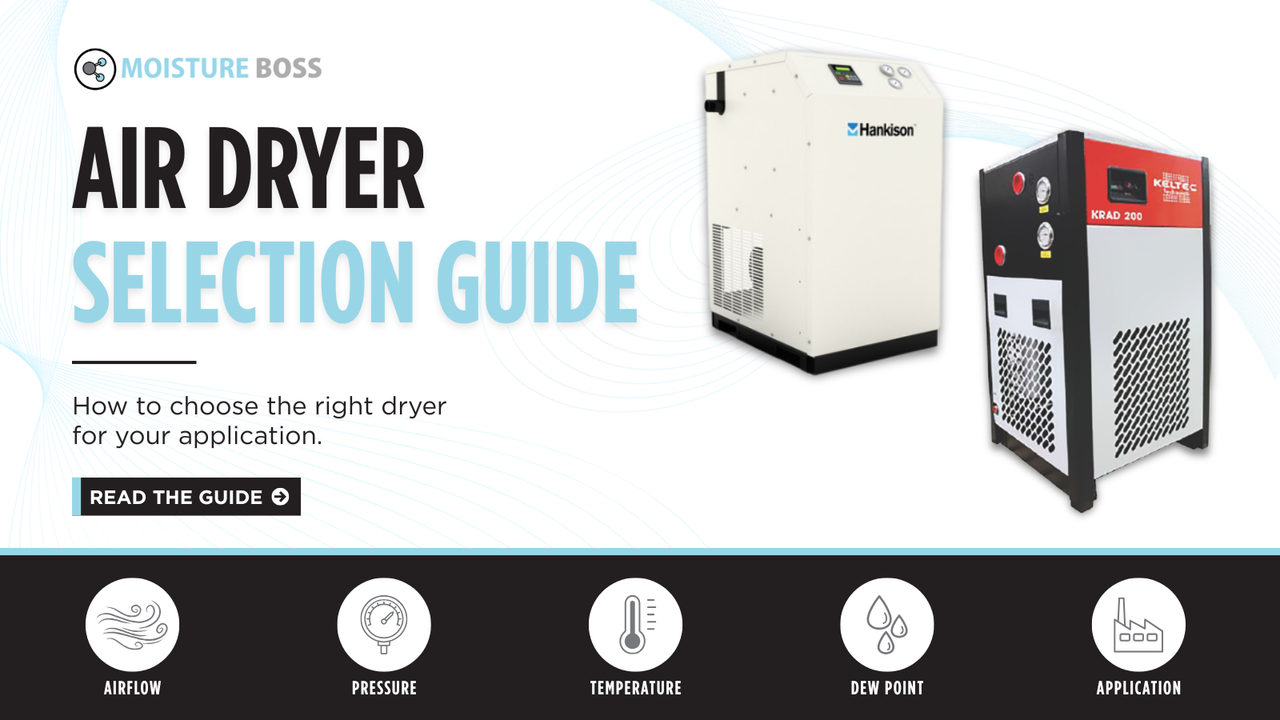
Air Dryer Selection Guide: How to Choose the Right Dryer
Posted by Moisture Boss on 08 03 2026
How to Choose the Right Compressed Air Dryer
Moisture is an unavoidable part of compressed-air production. Ambient air contains water vapor, and a compressor draws that moisture into the system along with the air. As compressed air cools, some of the water vapor condenses into liquid water.
Without effective moisture control, that water can contribute to corrosion, frozen air lines, damaged pneumatic equipment, inconsistent production, contaminated processes, and premature filter or component failure.
Choosing an air dryer is therefore not simply a matter of finding a model with the same airflow rating as the compressor. The dryer must be selected for the actual operating conditions, required air quality, application, and expected demand.
This guide explains the factors that should be evaluated when choosing a compressed air dryer, including:
- Maximum airflow
- Operating pressure
- Inlet-air temperature
- Ambient temperature
- Required pressure dew point
- Air-quality objectives
- Application requirements
- Future capacity
- Energy and maintenance considerations
Why Compressed Air Systems Need Dryers
Compressing air does not create water. It concentrates the water vapor that was already present in the ambient air.
The compressor raises the temperature of the air. While the air remains hot, much of its moisture can remain in vapor form. As the compressed air travels through an aftercooler, receiver, piping, or production environment, it cools. When it cools below its pressure dew point, water vapor begins to condense.
Some liquid water can be removed by:
- Aftercoolers
- Moisture separators
- Air receivers
- Coalescing filters
- Automatic condensate drains
These components are important, but they do not replace an air dryer. A separator can remove condensed liquid water, while a dryer reduces the amount of water vapor remaining in the compressed air.
If that vapor is not reduced sufficiently, more condensation may form as the air cools farther downstream.
Problems caused by moisture in compressed air
Excess moisture can contribute to:
- Corrosion inside piping and equipment
- Sticking or damaged pneumatic valves and cylinders
- Frozen outdoor air lines
- Instrument malfunctions
- Paint and finishing defects
- Contaminated products or processes
- Reduced filter life
- Premature wear in air-operated tools
- Unplanned maintenance
- Production interruptions
The correct dryer depends on how dry the air must be and the conditions under which the system operates.
What Determines Which Air Dryer You Need?
Air dryer selection should begin with the application, not with a product model.
The main factors are:
- Maximum compressed-air flow
- Normal and minimum operating pressure
- Maximum inlet-air temperature
- Maximum ambient temperature
- Required pressure dew point
- Air-quality requirement
- Installation environment
- Demand pattern
- Future expansion
- Energy and maintenance priorities
These variables interact. A dryer that is suitable at one pressure or temperature may have less usable capacity under different conditions.
That is why published nominal flow alone is not enough to make a final selection.
Understand the Main Types of Compressed Air Dryers
The first major decision is usually whether the system needs a refrigerated dryer or a desiccant dryer.
Other technologies are available, but these two categories cover many common industrial applications.
Refrigerated Air Dryers
A refrigerated dryer cools compressed air so that water vapor condenses. The condensed water is then separated and discharged from the system.
Refrigerated dryers are commonly used where the required compressed-air dryness is moderate and downstream piping will not be exposed to temperatures low enough to cause additional condensation or freezing.
Some refrigerated dryers are designed to deliver a pressure dew point near +37°F to +45°F under their stated rating conditions. The exact performance depends on the dryer design and operating conditions. One current manufacturer range, for example, lists performance as low as approximately +37.4°F pressure dew point.
Refrigerated dryers are often considered for:
- General plant air
- Machine shops
- Packaging operations
- Pneumatic tools
- Indoor manufacturing
- Automotive service facilities
- Applications where air lines remain above freezing
Advantages
- Lower initial complexity than many desiccant systems
- Moderate operating and maintenance requirements
- Appropriate for many general industrial applications
- Available in cycling and non-cycling designs
- Often lower energy demand than producing very low dew points unnecessarily
Limitations
- They do not normally provide the very low pressure dew points required by highly moisture-sensitive processes.
- They may not be suitable where downstream piping is exposed to freezing conditions.
- Their available capacity may decrease under high inlet-temperature or ambient-temperature conditions.
- The exact rating conditions and correction factors vary by product family.
Non-Cycling Refrigerated Dryers
A non-cycling dryer typically operates its refrigeration circuit continuously while the dryer is running.
This design may be appropriate for systems with relatively stable airflow and applications where simplicity is a priority.
Cycling Refrigerated Dryers
A cycling dryer adjusts refrigeration activity or thermal storage in response to demand.
This may reduce energy use in applications with variable or intermittent airflow. Whether the savings justify the additional system complexity depends on the load profile, operating hours, and specific dryer design.
Desiccant Air Dryers
Desiccant dryers use a moisture-attracting material to remove water vapor from compressed air.
Many industrial desiccant dryers use two vessels. One vessel dries the compressed air while the other regenerates its desiccant. The vessels then alternate.
Desiccant systems are commonly considered when the application requires a substantially lower pressure dew point than a refrigerated dryer can provide. A pressure dew point around -40°F is common in many desiccant applications, although actual capabilities vary by design and configuration.
Desiccant dryers are often considered for:
- Outdoor air lines exposed to freezing temperatures
- Instrument air
- Moisture-sensitive manufacturing
- Electronics processes
- Certain food, beverage, pharmaceutical, and laboratory applications
- Critical pneumatic controls
- Applications requiring very low pressure dew points
Advantages
- Capable of much lower pressure dew points
- Better suited to freezing environments
- Appropriate for critical or moisture-sensitive applications
- Available in multiple regeneration configurations
Limitations
- Higher initial and operating complexity
- Desiccant replacement and valve maintenance
- Potential purge-air consumption
- Greater need for correct prefiltration
- Risk of reduced performance if the desiccant becomes contaminated
- Higher energy or compressed-air cost in some configurations
Heatless Desiccant Dryers
A heatless dryer generally uses a portion of the dried compressed air to regenerate the offline desiccant vessel.
Its relative simplicity can be attractive, but the purge-air requirement must be included when evaluating total system demand and operating cost.
Heated Desiccant Dryers
A heated dryer uses external heat to assist regeneration.
The use of heat can reduce the amount of dried compressed air required for regeneration, but the system introduces heaters, controls, and additional energy considerations.
Blower-Purge Desiccant Dryers
A blower-purge dryer uses ambient air supplied by a blower during part or all of the regeneration process.
This can reduce compressed-air purge losses, particularly in larger systems. The evaluation should include electrical demand, ambient-air conditions, system size, and the operating sequence.
Heat-of-Compression Dryers
Some dryers use heat produced during compression to regenerate the desiccant.
These systems can be efficient in suitable compressor configurations, but their application depends heavily on compressor type, operating profile, temperature, and system design.
Refrigerated vs. Desiccant Air Dryers
| Selection factor | Refrigerated dryer | Desiccant dryer |
| Typical application: | General industrial air | Critical, moisture-sensitive, or freezing applications |
| Relative pressure dew point: | Moderate | Low to very low |
| Freezing exposure: | Generally not preferred where downstream condensation could freeze | Often considered for air lines exposed to freezing |
| Energy use: | Often lower for general plant-air requirements | Varies by regeneration method; may include purge loss or heat |
| Maintenance: | Refrigeration, drains, heat exchangers | Valves, filters, desiccant, heaters or blowers where applicable |
| Prefiltration: | Important | Critical to protect desiccant |
| Best use: | When moderate dryness is sufficient | When the process or environment requires substantially drier air |
How to Select a Compressed Air Dryer
Step 1: Determine the Maximum Required Airflow
Begin with the highest airflow the dryer will actually need to process.
Do not automatically use average plant demand. A dryer must be capable of handling the maximum expected inlet flow under the conditions for which it is selected.
Consider:
- Compressor rated flow
- Actual delivered airflow
- Simultaneous equipment demand
- Production peaks
- Shift changes
- Multiple compressors feeding a common header
- Planned equipment additions
- Purge demand from a desiccant dryer
- Leaks and artificial demand
- Whether standby compressors may operate simultaneously
Compressor horsepower is not enough
Horsepower can be used to create a rough airflow estimate when no better information exists, but it should not be the primary basis for final dryer selection.
Compressors with the same motor horsepower may deliver different airflow depending on:
- Compressor design
- Discharge pressure
- Efficiency
- Operating condition
- Control method
- Age and maintenance
- Manufacturer and model
Use measured or manufacturer-verified airflow whenever possible.
Size for peak flow, not nameplate assumptions
A plant with two compressors may normally run only one unit, but both may operate during peak production. The dryer must be selected for the actual intended operating scenario.
Likewise, a compressor may be rated at a certain flow, but system pressure, temperature, and control settings may affect what reaches the dryer.
Selection checkpoint
Document the highest expected dryer inlet flow and the operating scenario that creates it.
Step 2: Confirm the Operating Pressure
Dryer capacity is affected by pressure.
Published dryer ratings are based on specific inlet conditions. If the actual system pressure differs from the stated rating pressure, a correction factor may be required.
In general, a change in pressure changes the volume of compressed air the dryer must process and the amount of moisture contained in that volume.
A dryer may therefore have different usable capacities at different operating pressures. Current manufacturer data shows the same desiccant dryer model assigned different maximum inlet flow values as pressure changes.
Use the correct pressure value
Record:
- Normal operating pressure
- Minimum expected pressure
- Maximum pressure
- Pressure at the dryer inlet
- Required downstream pressure
- Expected pressure drop through filters and dryer
The minimum operating pressure can be especially important because a dryer selected only around a higher nominal pressure may not have enough capacity during lower-pressure operation.
Do not ignore pressure drop
Every air-treatment component introduces some resistance to flow.
The total treatment train may include:
- Moisture separator
- Prefilter
- Dryer
- Afterfilter
- Additional specialty filters
- Piping, valves, and bypass components
Pressure drop should be evaluated across the complete system, not just the dryer.
Excessive pressure drop can increase compressor energy use or reduce the pressure available to production equipment.
Step 3: Identify the Maximum Inlet-Air Temperature
The temperature of the compressed air entering the dryer can have a major effect on sizing.
Warmer air can hold more water vapor than cooler air. When hotter compressed air enters a dryer, the dryer may be required to remove a greater moisture load.
Dryer ratings are normally based on defined inlet-temperature conditions. If the actual inlet temperature is higher, the dryer’s corrected capacity may be lower than its nominal rating.
Sources of high inlet temperature
- Inadequate aftercooling
- High compressor-room temperature
- Fouled aftercoolers
- Restricted cooling-air flow
- High cooling-water temperature
- Short piping distance between compressor and dryer
- High compressor discharge temperature
- Seasonal summer conditions
Use the highest expected temperature
Do not size the dryer using a comfortable winter reading if the compressor room becomes substantially hotter in summer.
The selection should be based on the maximum credible inlet temperature under normal operation.
If the inlet temperature exceeds the dryer’s approved range, a larger standard dryer may not solve the problem. The system may require:
- Improved aftercooling
- Better ventilation
- A high-temperature dryer configuration
- Additional moisture separation
- A revised installation design
Engineering review required
The exact temperature correction factor must come from the manufacturer’s approved data for the product under consideration.
Step 4: Determine the Maximum Ambient Temperature
Ambient temperature is the temperature of the area around the dryer.
It may affect:
- Refrigeration-system performance
- Heat rejection
- Cooling efficiency
- Controls
- Condensate management
- The usable capacity of the dryer
- Whether the installation remains within the product’s operating limits
An indoor compressor room can operate well above the outdoor temperature, particularly when ventilation is inadequate.
For outdoor installations, consider:
- Maximum summer temperature
- Solar exposure
- Minimum winter temperature
- Rain and weather protection
- Dust
- Ventilation
- Freezing of drains or condensate lines
- Enclosure requirements
As with inlet temperature, ambient limits differ by product. Current manufacturer data commonly states defined minimum and maximum inlet and ambient conditions, demonstrating why the actual installation environment must be checked against the selected model.
Step 5: Define the Required Pressure Dew Point
Pressure dew point is one of the most important dryer-selection criteria.
It is the temperature at which water vapor in compressed air begins to condense at the operating pressure. It is not the same as atmospheric dew point.
A lower pressure dew point means the compressed air contains less water vapor.
For example, a system requiring general indoor plant air may not need the same dryness as an outdoor instrument-air line exposed to freezing conditions.
Atlas Copco’s published guidance describes refrigerated dryers as commonly producing pressure dew points in approximately the +37°F to +45°F range, while applications requiring substantially drier air may use a desiccant dryer capable of approximately -40°F pressure dew point.
These values are useful reference points, but they should not be applied as universal guarantees. Confirm the performance of the specific dryer under its actual operating conditions.
How dry does the air need to be?
Start with the application:
- What is the lowest temperature the downstream piping may experience?
- Can any air line be exposed to freezing?
- Does the compressed air contact a product?
- Is moisture likely to affect finish quality?
- Are instruments or controls moisture-sensitive?
- Is a customer, process, or standard specifying an air-quality class?
- Is the stated requirement a pressure dew point or atmospheric dew point?
- Where in the system must the requirement be met?
Avoid drying the air more than necessary
Producing a lower pressure dew point usually requires more equipment, energy, maintenance, or purge air.
A system should be dry enough to protect the application, but selecting the lowest possible dew point without a defined need may increase lifecycle cost unnecessarily.
Avoid selecting a dew point that is not low enough
If downstream piping reaches a temperature below the air’s pressure dew point, condensation may occur after the dryer.
Where air lines are exposed to low temperatures, the specified dew point should provide an appropriate margin below the coldest expected condition. That margin should be defined with the help of an air-treatment specialist for critical applications.
Step 6: Establish the Required Air Quality
Dryness is only one part of compressed-air quality.
Compressed air can contain:
- Solid particles
- Liquid water
- Water vapor
- Oil aerosols
- Oil vapor
- Microorganisms
- Other gaseous contaminants
ISO 8573-1 classifies compressed-air purity with respect to particles, water, and oil. It also identifies other forms of contamination.
A dryer primarily addresses water vapor. It does not independently control every contaminant.
A complete treatment system may also require:
- Moisture separation
- General-purpose particulate filtration
- Coalescing filtration
- Oil-vapor removal
- Sterile filtration
- Condensate drains
- Oil-water separation
- Point-of-use treatment
Do not specify a dryer in isolation
For a desiccant dryer, correct prefiltration is especially important. Oil or liquid-water contamination can damage the desiccant and reduce drying performance.
An afterfilter may also be required to capture desiccant dust before it reaches downstream equipment.
The correct treatment sequence depends on:
- Compressor type
- Contaminant load
- Required air-quality class
- Dryer technology
- Application
- Downstream risk
- Maintenance strategy
ISO 8573 requires application-specific interpretation
ISO 8573-1 defines purity classes, but the application owner must determine which classes are required and where they apply.
Do not assume that every industry or process uses the same class. Requirements may come from:
- Process engineering
- Customer specifications
- Equipment manufacturers
- Regulatory expectations
- Quality systems
- Risk assessments
- Internal plant standards
For regulated, product-contact, medical, pharmaceutical, food, laboratory, or critical manufacturing applications, obtain qualified technical and compliance review.
Step 7: Evaluate the Demand Profile
Two systems with the same peak flow may not have the same operating pattern.
One may run at full demand continuously. Another may operate at partial load for much of the day and experience only short peaks.
The load profile can affect:
- Cycling versus non-cycling dryer selection
- Energy consumption
- Dew-point stability
- Purge-air use
- Control strategy
- Number of dryers
- Need for redundancy
- Lifecycle cost
Questions to ask
- Does airflow remain stable or vary widely?
- How many hours per day does the system operate?
- Does the plant run one, two, or three shifts?
- Does production stop on weekends?
- Are there frequent short peaks?
- Are compressors sequenced?
- Must the dryer stay online during maintenance?
- Would one large dryer or multiple dryers offer better reliability?
For a critical plant, the best selection may not be the single lowest-cost dryer. Redundancy, turndown, and maintainability may be more important.
Step 8: Plan for Future Capacity
A dryer should not become undersized immediately after the plant adds a new machine or production line.
Consider:
- Approved expansion projects
- Planned compressor additions
- Additional shifts
- Seasonal demand
- New production cells
- Increased instrument-air use
- Known leak-reduction projects
- Changes to pressure
- Future air-quality requirements
A reasonable growth allowance can reduce the risk of early replacement.
However, “bigger is always better” is not a sound selection strategy. Excessive oversizing may:
- Increase capital cost
- Reduce the efficiency of some dryer types
- Create control or cycling issues
- Increase maintenance cost
- Take up unnecessary space
- Encourage the plant to ignore leaks or artificial demand
The correct margin should reflect realistic growth, not an arbitrary percentage applied to every project.
Step 9: Compare Energy and Lifecycle Costs
Purchase price is only one part of dryer cost.
The lifecycle evaluation may include:
- Electrical consumption
- Purge-air consumption
- Pressure drop
- Filter replacement
- Desiccant replacement
- Refrigeration maintenance
- Drain maintenance
- Heater or blower maintenance
- Lost production during service
- Cooling requirements
- Required redundancy
- Expected operating hours
Purge air has a real cost
A heatless desiccant dryer may use a portion of the dried compressed air for regeneration. That air was produced by the compressor, so it has an energy cost.
When selecting a desiccant dryer, account for:
- Required process airflow
- Dryer purge flow
- Compressor capacity
- Operating pressure
- Hours of operation
- Part-load behavior
Pressure drop also affects energy
If the treatment system creates excessive pressure drop, operators may raise compressor discharge pressure to maintain the required pressure at production equipment.
That can increase compressor energy consumption.
Evaluate clean and expected service pressure drop across the complete treatment train.
Step 10: Evaluate Maintenance and Installation Requirements
A dryer can only deliver its intended performance when it is installed and maintained correctly.
Installation considerations
- Adequate ventilation
- Correct pipe size
- Proper flow direction
- Isolation valves
- Service bypass
- Maintenance clearance
- Electrical supply
- Drain connection
- Condensate disposal
- Prefilter and afterfilter placement
- Receiver location
- Indoor or outdoor suitability
- Freeze protection
- Monitoring access
Maintenance considerations
- Condensate-drain inspection
- Filter-element replacement
- Heat-exchanger cleaning
- Refrigeration checks
- Valve maintenance
- Desiccant condition
- Purge settings
- Dew-point monitoring
- Differential-pressure monitoring
- Leak inspection
- Calibration of sensors and controls
The required maintenance resources should be considered during selection. A technically capable dryer that the plant cannot maintain may not remain capable for long.
How Air Dryer Correction Factors Work
Dryers are rated at defined operating conditions.
When actual conditions differ from the rating conditions, the nominal capacity may need to be corrected.
A simplified conceptual calculation is:
Corrected dryer requirement = maximum system flow ÷ combined applicable correction factor
A growth or design margin may then be applied.
The relevant correction factors may include:
- Operating pressure
- Inlet-air temperature
- Ambient temperature
- Required pressure dew point
- Cooling-water conditions
- Elevation
- Dryer technology
- Product-specific limitations
Example of the correction process
Assume a plant requires 300 SCFM at its peak condition.
After applying the manufacturer’s pressure, inlet-temperature, and ambient-temperature correction factors, the selected dryer may need a nominal rating above 300 SCFM.
The next available model above the corrected requirement would then be evaluated for:
- Pressure limits
- Temperature limits
- Dew-point performance
- Electrical configuration
- Pressure drop
- Accessories
- Availability
- Future growth
Do not use generic correction factors across every dryer
Correction tables can differ by manufacturer, dryer type, and product family.
Use the correction data supplied for the specific equipment being evaluated. Moisture Boss should verify the selected model and applied factors before a final purchase decision.
Common Air Dryer Selection Mistakes
-
Matching the dryer only to compressor horsepower
Horsepower does not define actual airflow or moisture load. Use verified airflow and operating conditions.
-
Using average flow instead of peak flow
A dryer that handles the average but not the peak can allow downstream moisture problems during high demand.
-
Ignoring inlet temperature
High inlet temperature can significantly reduce usable dryer capacity.
-
Ignoring ambient temperature
A hot compressor room or outdoor installation may push the dryer beyond its rating conditions.
-
Selecting a dryer by nominal SCFM alone
Nominal capacity applies only under the conditions stated by the manufacturer.
-
Choosing the wrong pressure dew point
A refrigerated dryer may be insufficient for freezing or moisture-sensitive applications. A very low dew point may also be unnecessary for ordinary indoor plant air.
-
Confusing pressure dew point with atmospheric dew point
These are not interchangeable. Verify which value the application or specification requires.
-
Forgetting desiccant purge demand
The compressor may need to supply both process air and the air required for dryer regeneration.
-
Ignoring prefiltration
Contaminants can reduce dryer performance and damage desiccant systems.
-
Failing to maintain condensate drains
A failed drain can allow separated water to re-enter the air stream or create operational problems.
-
Neglecting downstream temperature
Air that is dry enough inside a warm compressor room may condense when it enters colder piping.
-
Oversizing without a defined reason
Excess capacity increases cost and may not improve system performance.
-
Failing to plan for maintenance
Without isolation, bypass, or redundancy, routine service may interrupt production.
-
Treating the dryer as the entire treatment system
Drying, filtration, separation, drainage, and condensate management should be designed together.
Air Dryer Selection Checklist
Before requesting a recommendation or quote, gather the following information:
System demand
- Maximum required airflow
- Normal airflow
- Compressor manufacturer and model
- Number of compressors
- Simultaneous operating scenario
- Hours of operation
- Demand variability
Operating conditions
- Normal operating pressure
- Minimum operating pressure
- Maximum pressure
- Maximum dryer inlet temperature
- Maximum ambient temperature
- Indoor or outdoor installation
- Elevation, if relevant
Air-quality requirements
- Required pressure dew point
- Lowest downstream piping temperature
- Required ISO 8573 class, if specified
- Particle, oil, and water requirements
- Product-contact or critical-process status
Installation requirements
- Available voltage and phase
- Pipe connection
- Space limitations
- Acceptable pressure drop
- Drain and condensate-disposal requirements
- Need for bypass or redundancy
Commercial and operational requirements
- New system or replacement
- Existing dryer manufacturer and model
- Reason for replacement
- Planned growth
- Purchase timeframe
- Maintenance preferences
- Energy priorities
Frequently Asked Questions
How do I size a compressed air dryer?
Start with the maximum airflow the dryer must process. Then correct the requirement for the actual operating pressure, maximum inlet temperature, maximum ambient temperature, required pressure dew point, and any other factors identified by the manufacturer.
Select a dryer whose corrected capacity exceeds the application requirement and whose operating limits fit the installation.
Should the dryer SCFM match the compressor SCFM?
Not necessarily.
The dryer should be selected for the maximum flow it will receive under actual operating conditions. That may equal the compressor rating, but corrections for pressure and temperature may require a dryer with a higher nominal rating.
Multiple-compressor systems require special attention because more than one compressor may feed the dryer.
Can an air dryer be undersized?
Yes.
An undersized dryer may not consistently achieve the required pressure dew point. Possible symptoms include downstream condensation, high dew-point alarms, excessive cycling, or moisture during peak demand.
Can an air dryer be oversized?
Yes.
Some reserve capacity can support growth or difficult operating conditions, but excessive oversizing can increase capital cost and may reduce the operating efficiency of certain designs.
The margin should reflect a real operating or growth need.
What pressure dew point do I need?
The correct pressure dew point depends on the application and the lowest downstream temperature.
General indoor plant air may often be served by a refrigerated dryer. Outdoor lines exposed to freezing, instrument air, and moisture-sensitive processes may require a desiccant dryer and a substantially lower pressure dew point.
Critical applications should be reviewed individually.
Do I need a refrigerated or desiccant dryer?
A refrigerated dryer is often considered for general industrial applications where moderate dryness is sufficient, and air lines remain above freezing.
A desiccant dryer is often considered when the system requires a low-pressure dew point, the piping may freeze, or the process is highly moisture-sensitive.
Does operating pressure affect dryer size?
Yes.
Dryer capacity can change with operating pressure. Use the manufacturer’s approved pressure correction factor and evaluate the minimum expected operating pressure.
Does inlet temperature affect dryer capacity?
Yes.
Higher inlet temperature generally increases the moisture load and can reduce the dryer’s usable capacity. Use the maximum expected dryer inlet temperature.
Does ambient temperature matter?
Yes.
Ambient temperature can affect heat rejection and dryer performance, particularly for refrigerated dryers. Confirm that the installation remains within the selected model’s operating limits.
Does altitude affect air dryer sizing?
It can.
Elevation changes ambient pressure and may affect compressor and treatment-equipment performance. High-elevation applications should be reviewed using product-specific engineering guidance.
Do I need filters with an air dryer?
Most systems need filtration in addition to drying.
The required filter arrangement depends on compressor type, dryer technology, air-quality objective, and application. Desiccant dryers usually require effective prefiltration to protect the desiccant, and they may require an afterfilter for desiccant dust.
Should the dryer be installed before or after the air receiver?
The correct arrangement depends on the system design, control strategy, dryer type, demand profile, and desired function of the receiver.
Wet receivers and dry receivers serve different purposes. Have the complete system arrangement reviewed rather than positioning the dryer based on a universal rule.
How much future capacity should I add?
Use a margin based on realistic, documented growth.
Consider known equipment additions, production expansion, and demand changes. Avoid adding an arbitrary margin that creates unnecessary cost or operating problems.
Why is there still water downstream of my dryer?
Possible causes include:
- Dryer overload
- High inlet temperature
- High ambient temperature
- Incorrect pressure
- Failed condensate drain
- Bypass valve left open
- Fouled heat exchanger
- Saturated or contaminated desiccant
- Inadequate prefiltration
- Downstream piping colder than the pressure dew point
- Excessive pressure drop
- Dryer malfunction
A dew-point measurement and system inspection may be required to identify the cause.
Choose the Dryer for the Application, not Just the Compressor
The right air dryer is the one that consistently delivers the required air quality under the system’s most demanding operating conditions.
A reliable selection should account for:
- Maximum airflow
- Actual operating pressure
- Maximum inlet and ambient temperatures
- Required pressure dew point
- Air-quality objective
- Application risk
- Demand profile
- Purge and energy use
- Maintenance needs
- Future growth
- Complete filtration and condensate management
Nominal SCFM is only the starting point.
Moisture Boss can help review your application, apply the relevant product correction factors, and identify the dryer and treatment components that fit your operating conditions.
Need Help Choosing the Right Air Dryer?
Provide your airflow, pressure, temperature, dew-point, and application information. A Moisture Boss air-treatment specialist can review the conditions and help identify appropriate options.